


Annual Review of Schubert's Life
1826
Close association with the Gesellschaft der Musikfreunde now gave Schubert a secure standing in the musical life of Vienna, and this was reinforced by the increasing number of performances of his music that were to be heard, especially of his songs, and also by the developing interest of publishers in both his songs and piano music. Copies of portraits of Schubert were put on sale in Vienna, attesting to his growing reputation and popularity. All in all the outward impression was of a successful young composer living in comfort.Schubert’s indisposition over the New Year may only have been a passing ailment for he appeared at Schober’s for a Schubertiad on 10th January. Bauernfeld, knowing that Schubert was going to be present had invited Johann Gabriel Seidl to come to a "feast of song", and the consequence of this reintroduction of Seidl to Schubert (they had met before but their relationship had not flourished) resulted in the setting of six songs and three part-songs to texts by Seidl during this year, and more settings would follow in 1828. It is largely through the diaries kept by Eduard von Bauernfeld, who had grown closer to Schubert over recent months, and by Sophie Müller, to whom Schubert may well have been attracted, that we know of the flurry of Schubertiads, balls and musical events that were now taking place. Following this Schubertiad of the 10th Schubert was playing waltzes through the evening for a Würstball (a ‘sausage ball’) on the 14th of January. Two days earlier the Gesellschaft der Musikfreunde had included Rastlose Liebe (D138) in its evening programme; on the 20th the Wiener Zeitung announced the publication of 50 New Waltzes composed by, among others, Beethoven, Czerny, Hummel and Schubert; and on the 25th of January Schubert ate at Sophie Müller’s and "sang songs from Ernst Schulze poems composed by him".
Things were moving rapidly for Schubert. The first rehearsal of the D Minor Quartet Der Tod und das Mädchen (D810) followed quickly, on the 29th January, with Schubert correcting the freshly copied parts; the second rehearsal was the following day (30th) at which Schubert is known to have cut part of the first movement. The first performance took place at Joseph Barth’s in Prince Schwartzenberg’s winter palace on the 1st February, and the second, presumably only a few days later, at Franz Lachner’s, Lachner being one of the assistant conductors at the Kärtnertor-Theater.
The publisher Artaria paid Schubert 300 florins VC (WW) for the D Major Piano Sonata Op.53 of August 1825 (D850) and the Divertissement à la hongroise for Piano Duet Op.54 of 1824 (D818) on his birthday, 31st January. Other publications and performances followed and the Leipzig Allegemeine Musikalische Zeitung published an extensive and favourable review of the A Minor Piano Sonata Op.42 (D845) on the 1st March. On 6th April Weigl published a group of Schubert songs about which he advertised that the "valued composer…has directed his attention to the elimination of any difficulty in the pianoforte accompaniment". The previous day (5th April) the Wiener Zeitung had carried an advertisement by Artaria for the seven Scott songs that had proved to be such a success wherever Vogl and Schubert performed them on their travels during the preceding summer.
Sophie Müller had been keen enough to buy the "Second half of Schubert’s songs [from] Walter Scott’s ‘Lady of the Lake’ – 2 Florins 24 Kreuzer" on 4th April, and had apparently bought her own copy of the new "lithographed portrait of Schubert" directly from the artist Josef Teltscher when he brought it to her home on 14th January.
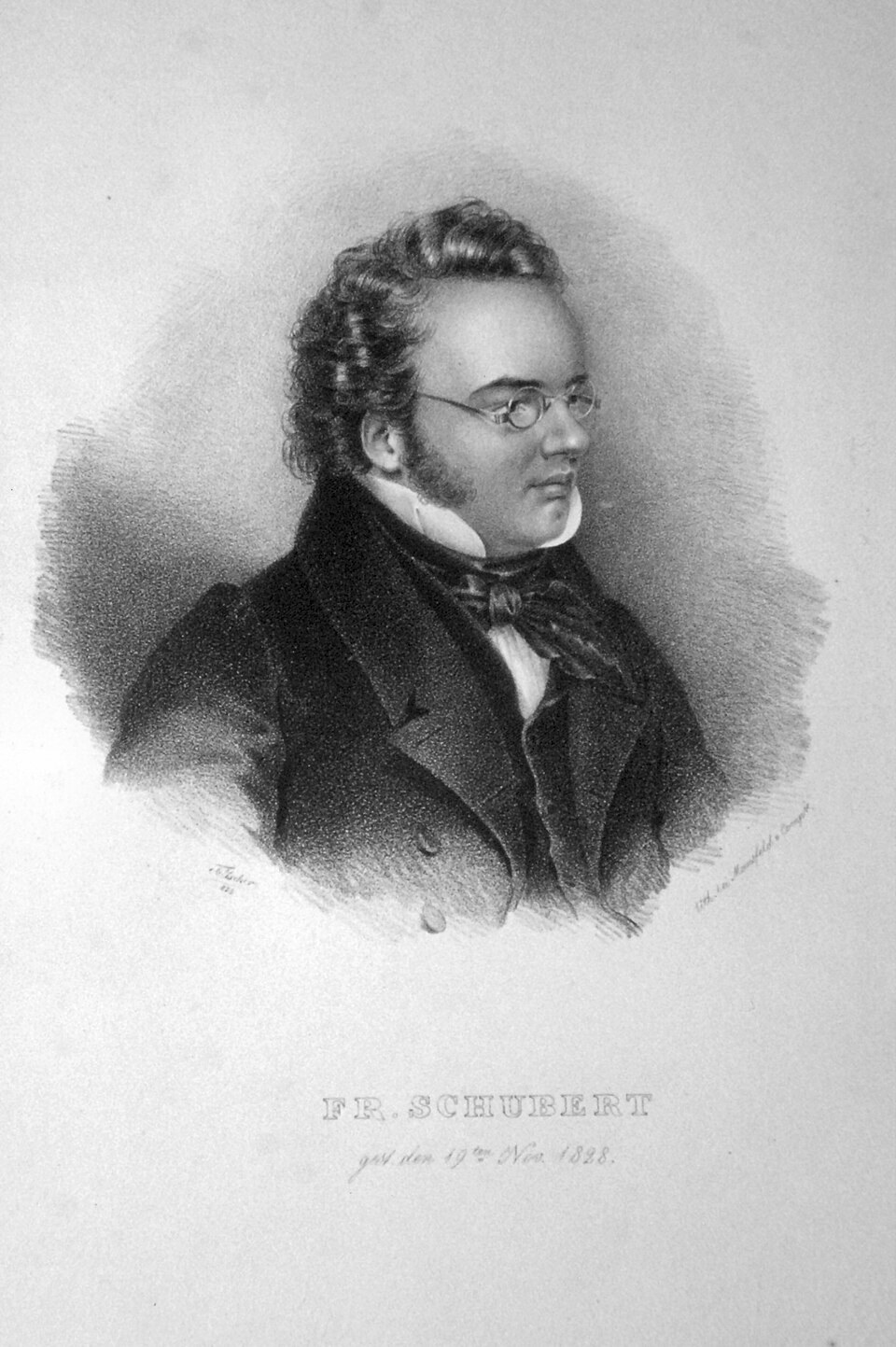
Franz Peter Schubert
31 Jan. 1797 - 19 Nov. 1828
Josef Teltscher, Lithograph, 1826
By the end of February Bauernfeld received the final payment for his translations of Shakespeare, and now lacking any other income, undertook a paid trip to survey and map parts of Carinthia with Mayerhofer. Before Bauernfeld left Schubert asked him to prepare an opera libretto on the subject of Der Graf von Gleichen whilst on the journey.
Schubert would badly miss Bauernfeld and Mayerhofer, Vogl was absent for much of the year and Schober had his own troubles. Schubert can hardly have had his spirits lifted by his narrow escape from involvment when the police raided the Ludlams Höhle club in the city in April. This was yet another example of Metternich’s heavy hand in cracking down on groups displaying artistic or intellectual interests, fearing them as harbouring ‘democratic’ ideas or being otherwise disaffected from the regime. The club included many international names such as Weber, Salieri, Moscheles, Rellstab and Rückert, as well as friends of Schubert including Kupelwiese and Seidl. Many of those present at the time of the raid were put under house arrest and had their homes searched. Schubert and Bauernfeld fortunately were not present having only just been accepted into the club but not yet formally enrolled.
Even the presence back in Vienna of Anselm Hüttenbrenner did little to lift the gloom which fell on Schubert in May. Writing to Bauernfeld and Mayerhofer at the end of that month Schubert complains,
"I am not working at all. – The weather is truly appalling, the Almighty seems to have forsaken us altogether, for the sun simply refuses to shine. It is May, and we cannot sit in any garden yet. Awful! appalling!! ghastly!!! and the most cruel thing on earth for me!"Schober would also appear to have been unwell or depressed during this period and was being missed by Schubert. Schober and his mother found themselves in serious disagreement over money matters. Apart from his general extravagance she considered that he had been squandering the family inheritance by keeping open house, making their home freely available to entertain groups of friends for Schubertiads, dances and parties. Worse, they had now to move out of their pleasant apartment and to live in the suburbs at Währing for a time, and of necessity Schober had to find paid employment, commuting into Vienna each day. Not only was Schubert unable to see Schober for a time but their friend Schwind too was out of sorts and not good company for anyone.
Knowing that Schubert could well do with a break Bauernfeld wrote to him from Gmunden, where he had stopped off when he separated from Mayerhofer, asking Schubert to come out and join him there. It would also provide him with the opportunity to give Schubert the newly prepared libretto of Der Graf von Gleichen. Unable to afford the trip Schubert wrote to Bauernfeld on 10th July to say, "It is impossible for me to come to Gmunden or anywhere else, for I have absolutely no money, and everything else is going very badly with me. However, I am bearing up and in good spirits." It would appear that Schubert could have written little during April and May. It is all the more remarkable then that about the time of this plaintive letter in July Schubert was setting the three Shakespeare songs, ‘Trinklied’, ‘Horch, horch die Lerch’ and ‘An Sylvia’ (D888, 889 & 891), and it could only have been a matter of days earlier that he had completed what is arguably the greatest of his String Quartets, that in G Major (D887).
Unfortunately Schubert’s income from publication was not proving sufficient to maintain the expense of his comfortable apartment on the edge of the city and at some time, perhaps not too long after this letter was written, he would be forced to leave. The absence, or unavailability, of many of his close friends for much of this year had proved a depressant, and with Vogl missing from his life during the greater part of this year (on 26 June Vogl was married to Kunigunde Rosa) Schubert was left without both the moral and the material support that had proved essential to him from the the time that they were first introduced in the autumn of 1817. Having left his pleasant apartment Schubert moved in with the Schobers where Schwind also lived as a renter for a time, and then upon their return to Vienna in the autumn moved with them to their apartment in the Bäckerstrasse, this time (as also must have been the case at Währing) as a paying tenant. Economic necessity now forced him to approach the publishers Breitkopf & Härtel and Probst in the hope of gaining some quick financial return, but neither publisher expressed any interest.
The return of Bauernfeld to Vienna after his three month trip was greeted with delight by Schubert and Schwind who promptly whisked him off to the Schober’s at Währing to celebrate his return, Schubert being especially excited by the new libretto.
Two part-songs to poems by Seidl in September would seem to represent the total of new vocal pieces after July, but revisions to such an immense work as the ‘Great’ C Major Symphony (D944) may well have occupied him fully throughout the autumn. Schubert eventually presented the score of this symphony to the Gesellschaft der Musikfreunde, probably in December. The directors had already agreed to pay him a sum of 100fl. KM, not in anticipation of the symphony which had been promised to them, but as they were aware of his current hardship, with the intention of helping him over a difficult period.
At times of adversity something in Schubert impelled him to produce his finest work and in this year, beyond the monumental task of this revision he produced his fine String Quartet in (G Major, D887), and in October the Piano Sonata also in G Major (D894), originally published as the Fantasia in G. Songs to Goethe texts in January (the ‘Wilhem Meister’ songs) and songs to texts by Shakespeare, Seidl, Schulze and others round out a year of achievement.
Schubert was to round out his year with a series of parties. Works were once again appearing in print; compositions had appeared in four of the evening programmes of the Gesellschaft between mid-November and the year end; Josef von Spaun was back in Vienna and Schubert’s spirits were lifted. Indeed, from the time of the return of Spaun, for Schubert and his friends it was a whirl of parties, feasting, dancing and Schubertiads.
A postscript relating to events in the paternal household within this year would seem inevitable, for another son was born to his father (a half-brother to Schubert) in early February, and later in that same month, on the 23rd, Schubert’s father was granted the honour of citizen’s rights of Vienna (das Bürgerrecht der Stadt Wien).
Notable works of 1826:
- D877 Gesänge aus Wilhelm Meister: Goethe songs 1826 Jan
- D877a B minor Mignon und der Harfner - Nur wer die Sehnsucht kennt
- D877b E minor Lied der Mignon - Heiss mich nicht reden
- D877c B major Lied der Mignon - So lasst mich scheinen
- D877d A minor Lied der Mignon - Nur wer die Sehnsucht kennt
D867 CWiegenlied Seidl song 1826 Mar?
D870 G min Der Wanderer an den Mond Seidl song 1826 Mar
D871 A flat major Das Zügenglöcklein 2 versions Seidl song 1826 Mar
D878 F major Am Fenster Seidl song 1826 Mar
D879 D minor Sehnsucht Seidl song 1826 Mar
D880 E flat major Im Freien Seidl song 1826 Mar
D887 G major String Quartet 15 (Op posth.161) 1826 20-30 Jun
D888 C major Trinklied Shakespeare song 1826 early Jul
D889 C major Ständchen ("Horch, horch die Lerch") Shakespeare song 1826 early Jul
D891 A major Gesang ‘An Sylvia’ Shakespeare song 1826 early Jul
D892 B major Nachthelle Seidl T,TTBB, pianoforte 1826 Sep
D893 A minor Grab und Mond Seidl TTBB 1826 Sep
D894 G major Piano Sonata (18) known formerly as Fantasia in G 1826 Oct
D944 C major Symphony (9) "The Great" orch 1825 Revised for presentation to the Gesellschaft der Musikfreunde autumn 1826
Introduction | 1805-13 | 1814 | 1815 | 1816 | 1817 | 1818 | 1819 | 1820 | 1821 | 1822 | 1823 | 1824 | 1825 | 1826 | 1827 | 1828