


Annual Review of Schubert's Life
1828
On the stroke of midnight Schubert drank a toast with his friends to a happy new year and, no doubt, to their continued good health. The toast was in Malaga wine, and the friends gathered at Schober’s were Spaun, Enk, Schober himself, Gahy, Eduard Rössler, Bauernfeld, Schwind and the Hartmann brothers, Franz and Fritz. The diaries kept by the brothers through the previous year had added much to our understanding of Schubert in detailing the company he kept, his moods, his relaxations, together with the musical life that surrounded him that always gave them so much pleasure. It is unfortunate for us that the diaries were not maintained from the autumn to the end of the year, but now with the turn of the year Franz von Hartmann’s diary recommences although in somewhat briefer form, and it is noticeable that Schubert’s name is now mentioned but occasionally.Schubert had without doubt other preoccupations at this time. He was nurturing the hope of arranging a Benefit Concert of his own music, and if this were to be successful he knew that it could project his name forward on the world stage; he knew too that success in this venture could prove to be personally profitable. For the present there would need to be new works written, artists to be chosen and existing pieces prepared for rehearsal. In the event he was unable to complete the projected cantata Mirjams Siegesgesang (D942) to words by Grillparzer in time for the concert and this was replaced in the programme by Ständchen (D921), also with words by Grillparzer, and which had already been performed (twice in fact, firstly in a garden on the occasion of the birthday of Louise Gosmar for whom it was written, and later, on 24th January 1828 in the Musikverein), a piece therefore with which both the singer and the chorus were familiar. A major work that he had intended to present, and on which he had been working since early in the year, was the Piano-duet Fantasie in F-minor (Op103, D940), but pressure of work meant that although he had completed it, and indeed had listed it as one of the works offered to Schott’s (the publishers), he may have felt that it still needed revision and was not yet fitted for this occasion. The fair copy is dated April 1828, although the first sketch bears a date from January. The work is dedicated to the Countess Caroline (Karoline, Kontesse Esterházy de Galantha), and there has been a fanciful suggestion that the notes C and F forming the motto of the opening theme represent the names together of Caroline and Franz.
It is likely, then, that he would often be away from the activities of his old friends and that there would be many events, including performances of his own music, that he would fail to attend. He does however seem to have been distancing himself from those friends. Schober had restarted the reading group after some years, but this failed to draw his interest although he was living in the same house. He could no longer be found at his old haunts, but made for the ale-house that was favoured by the professional musicians – the Oak Tree (Zur Eiche). There he could spend time with the violinists Schuppanzigh, Slawjk, Böhm and Holz, the cellist Linke and the horn-player Josef Lewy whom he hoped would give their services at his Benefit – but this was increasingly to the neglect of those who had promoted his music. Gerhard von Breuning recalls, "On the birthday, for which the Ständchen was intended and on which it was to be performed for the first time … I had had the piano carried secretly under the garden window and had invited Schubert to the performance. But he did not come. The next day, when I asked him why he had stayed away, he apologised, ‘Oh dear! I forgot all about it’. Then Breuning arranged a performance of Ständchen at the Musikvereinsaal, but again Schubert did not appear, and was then found at the ‘Oak Tree’ pub. "But after the performance" says Breuning, "he appeared quite transfigured and said to me ‘Do you know, I had no idea it was so beautiful’. Mrs McKay succinctly expresses the tensions that this kind of behaviour created around Schubert, noting that "Personal friends might put up with his thoughtlessness, but others, especially those relying on him to entertain their guests on a professional basis, were understandably less tolerant, and their employment of him soon began to fall away."[1] It is highly probable that the appearances now of Schubert at ‘society’ events, especially with Vogl singing, would be for a fee.
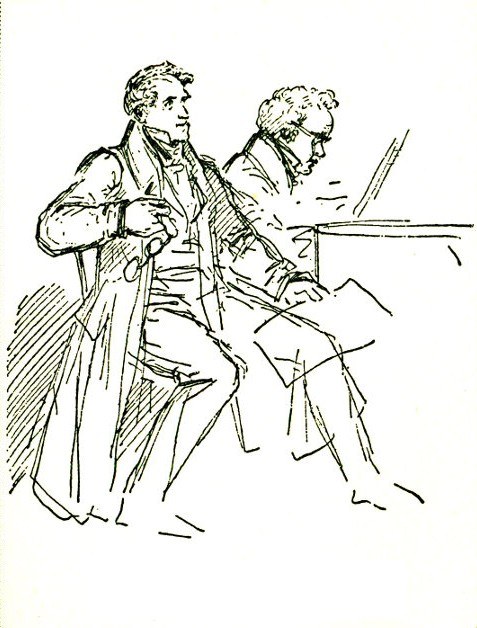
Franz Schubert and Johann Michael Vogl performing a song
Moritz von Schwind, Pen and Ink drawing, 1868
The first entry in Franz von Hartmann’s diary that mentions Schubert after the New Year party at Schober’s marked an important Schubertiad at Spaun’s on 28th January, when with fifty people, Schubert heard an early private performance of his E-flat Major Piano Trio Op.100 (D929) played by Schuppanzigh, Linke and Bocklet in advance of his big concert, where it would bear the important legend of being a ‘New Work’, i.e. one previously unheard in public. A ‘New Trio’ had in fact been presented at the Gesellschaft der Musikfreunde on the previous 26th December, but as Eva Badura-Skoda concludes[2], that Matinée Concert must have been of the Piano Trio in B-flat Major, Op.99 (D898). A couple of days later there was another Schubertiad at the Witteczek’s. Throughout February, whether in the composer’s presence or not, he was represented by a work at each of the Musikfreunde evening concerts. At the Eleventh Concert, Psalm 23 (D706) was performed by Josefine Fröhlich and the ‘lady pupils’ of the Conservatoire, and conducted by Anna Fröhlich for whom it was had been written; at the Twelfth, Ellens Gesang (probably No.III, Ave Maria D839); and at the Thirteenth Concert on the 28th February the four-part song Gott in der Natur (D757). This was the last performance at the Gesellschaft der Musikfreunde of a Schubert work in his lifetime.
Schubert’s Private (Benefit) Concert, eventually given on 26th March, after a confusion of dates – and on the first anniversary of Beethoven’s death – was a great artistic and financial success. Bauernfeld tells us that Schubert benefited by 800 fl.WW (320fl.KM). Reports appeared in papers as far afield as Leipzig, Dresden and Berlin, but strangely it was scarcely noted in the Viennese press which devoted itself to details of a private concert given by Linke a few days earlier in memory of Beethoven. Schubert was perhaps unfortunate in another respect, as Paganini was in Vienna at this time and gave his own first concert just three days later, on the 29th. Schubert may have been present at Paganini’s first concert, or at any rate at one of the early ones, and we know that he went again taking Bauernfeld with him. Bauernfeld’s diary entry for 9th May reads, "Heard Paganini. The admission (5fl.) was paid for me by Schubert … Today Schubert (with Lachner) played his new, wonderful four-handed Fantasy to me". As Schubert had been unable to put the F minor Fantasy into his Concert programme, the items actually performed comprised the first movement of his G Major String Quartet D887 (first performance); four songs given by Vogl and Schubert (Der Kreuzug D932, Die Sterne D939, Fischerweise D881, Fragment aus dem Aeschylus D450); the Ständchen, mentioned above, by Grillparzer, D921; The ‘New Trio’ in E-flat D929 (in which Böhm replaced Schuppanzigh who was unwell); Auf dem Strom D943, a song with horn and piano given by Tietze, Lewy and Schubert; Die Allmacht D852, Vogl and Schubert; Slachtgesang (Klopstock) – double male-voice chorus (and probably accompanied), D912. Schubert, accompanied the vocal works at the piano, something that, until the previous year, he had always refused to do in public.
As in earlier years Schubert seems to have entered a period of compositional inactivity in or around April, and once again this may have been just a brief depressive period – in this instance perhaps after the elation of his big concert had passed. In mid-April after an exchange of letters Probst bought the E-flat Piano Trio for publication, sending Schubert just 60 fl instead of the 100 fl he had been asking, rejecting out of hand the Violin and Piano Fantasy but asking for ever-popular ‘trifles’. Schubert with reluctance accepted the fee he sent, perhaps in the end believing that there could be some advantage in being on the books of this publisher. By the 4th May Schubert appears to have been in better form. Hartmann writes in his diary that he had gone to the ‘Snail’ inn (Zur Schnecke) where he was with Enk, Schober and Enderes; ‘When these three had gone, Schubert came, and I sat on there with him quite merrily until 12.20’. Bauernfeld’s visit with Schubert to hear Paganini was on the 9th of May. At the end of May a set of three piano pieces (published ultimately in Winterthur in 1868 edited by Brahms, under the title Drei Klavierstücke, D946) marks Schubert’s renewed compositional activity, and an impassioned four-hand duet soon followed, also published in 1868, by Diabelli, as Lebensturme (D947). June marks the beautiful four-hand Rondo in A (D951), and it would have been around this time that the Mass in E-flat (D950) was begun. There is no indication that Schubert’s health was giving any cause for concern at this time, although we do know from his letter to Frau Pachler of the previous October that he was being plagued by headaches – but the impression given by contemporary documents is of a man able to enjoy himself, although there lingers some dispute as to whether that included the over-indulgence in alcohol.
By September however matters had evidently changed, and on the 25th Schubert wrote to Jenger with whom he had planned to go to Graz with hopes of staying with the Pachlers, saying – ‘Nothing will come of the journey to Graz this year, as money and weather are wholly unfavourable’. Newbould raises an interesting question, why money and weather? As to money, Schubert had received income from a greater than average number of publications in this year and also substantial receipts from his March concert – and what was this about future weather? "Was he offering Jenger reasons?", asks Newbould, "or excuses?" "The real cause of Schubert’s reluctance to travel was more likely to have been a deterioration in his health."[3] There remains the possibility that if Schubert was now recognising the full nature of his illness, then he may well have been reluctant to spend money that could be needed for future medical attention.
If we were to judge by the number of works dated to August, then that would appear to be a barren month, but in fact through August, and September especially, Schubert must have been experiencing an extraordinary spell of activity. Having become frustrated by the slowness of Schott’s in publishing his (second) set of four Impromptus (Op.142 D935), and Probst in publishing the E-flat Trio Schubert wrote letters to each of them on the same day, 2nd October, urging the appearance of these works. It is his letter to Probst that reveals the extent of his activity when he says that ‘I have composed, among other things, 3 Sonatas for pianoforte solo, which I would like to dedicate to Hummel. Moreover, I have set several songs by Heine of Hamburg, which pleased extraordinarily here, and finally turned out a Quintet for 2 violins, 1 viola and 2 violoncellos.’ The astonishing fact is that the items listed contain the three greatest of his piano sonatas, and for many of us, the finest of his chamber works. The worrying aspect lies in the final words of the letter – ‘If perchance any of these compositions would suit you, let me know’. Schubert appears prepared to sell off the Heine songs, although he had planned to publish these together with the Rellstab settings as a cycle dedicated to his friends, in what does look like a sacrifice to financial need.
This letter, like the letter to Schott’s and the slightly earlier letter to Johann Baptist Jenger of 25th September, concludes with Schubert noting his address now as at the Neue Wieden suburb, marking that he had now moved out from the Schober’s to stay in the care of his brother Ferdinand – and there it was that some of his greatest works came to be completed. We may assume that he thought this arrangement to be only temporary as he left many of his manuscripts behind at Schober’s in the ‘music closet’. It is unfortunate for us today that Franz von Hartmann and his brother Louis had to return to their home in Linz on August 30th, and in consequence there are no further diary entries to tell us more of this period and to guide us through the following two months. As much as possible has therefore to be gleaned from later, and sometimes widely differing reminiscences. Nevertheless it seems clear that the move out of the city was made on the advice of Schubert’s doctor (Rinna), as was also the recommendation of serious exercise by taking long walks. As a result Schubert with his brother and a friend undertook a three day walking tour in Lower Austria and the Burgenland, taking in Eisenstadt where they paid a visit to Haydn’s tomb. On his return, feeling temporarily better, Schubert started work again. It was in October that he came to write his last solo song Die Taubenpost D965a, and the ecstatically beautiful chamber song Der Hirt auf dem Felsen (The Shepherd on the Rock) D965. There are also sketches for what would have been a 10th Symphony that may date from this late stage in his life – now realised by Newbould. Soon, however his condition began to worsen and on the 31st October whilst eating fish at the Red Cross inn he reacted with disgust, feeling himself to be poisoned. Ferdinand considered retrospectively that this marked the beginning of his final decline. Although Schubert was able to go out a few days later for the first of the counterpoint lessons that he had sought with Sechter he was far from well enough to go for the second on either the 10th or 11th November. On the 12th he wrote the last letter of his life, addressed to his friend Schober, and saying ‘I am ill. I have eaten nothing for eleven days and drunk nothing, and I totter feebly and shakily from my chair to bed and back again…If ever I take anything I bring it up again at once’.
At Ferdinand’s house Schubert was now receiving both nursing and medical attention, being finally confined to his bed. However, the apartment that Ferdinand had moved into was in a house that was both new and damp, in a suburb that was being newly built outside Vienna and on a street with as yet no name. The water supply and sanitation were inadequate even by the standards of the time. Although this must be uncertain, the possibility of Schubert contracting a bacterial typhoid infection cannot be ruled out, and on a body seriously weakened by tertiary syphilis and by the assimilation of mercury used in its treatment, such an infection may well have contributed to the rapid collapse of his system. There are nonetheless many imponderables about causes, and indeed uncertainties about the symptoms. Widely differing alternatives have been offered – it has been suggested, for instance, that Schubert’s headaches and giddiness could have been the result of unsuitable glasses and long working hours in poor light as much as from his illness; or again, that the illness itself had become so far advanced that it had now reached the heart in the form of advanced cardiovascular syphilis – and both McKay and Newbould in their biographies of the composer carefully, and individually, examine a wide range of possible causes for Schubert’s final illness and for his sudden decline. Schubert died on Wednesday, 19th November at 3 o’clock in the afternoon. His last conscious act was the correction of proofs for Part II of Winterreise on the previous day. Spaun says that in death he looked peaceful, his amiable countenance unchanged.
Notable works of 1828:
D936a D major Symphony Sketches for a 10th Symphony late 1828? (realization by Newbould)D940 F minor Fantasie (Op.103) pf duet 1828 Jan-Apr
D943 E major Auf dem Strom Rellstab pf,Vc,Hn song 1828 Mar
D946 Drei Klavierstücke (or Three Impromptus): 1828 May
D946/1 Eb minor Klavierstück pf 1827 May
D946/2 Eb major Klavierstück pf 1827 May
D946/3 C major Klavierstück pf 1827 May
D947 A min Allegro Lebensstürme pf4 1828 May
D950 Ebmaj Mass 6 S,A,T,B,SATB,orch 1828 Jun
D951 A major Rondo pf4 1828 Jun
D956 C maj String Quintet 2vn,va,2vc 1828 Sep ?
D957 ‘Schwanengesang’: 14 songs 1828 Aug-Oct
D958 C minor Piano Sonata (19) pf 1828 Sep
D959 A major Piano Sonata (20) pf 1828 Sep
D960 Bb major Piano Sonata (21) pf 1828 Sep
D965 Bb major Der Hirt auf dem Felsen Müller song 1828 Oct
D965a G major Die Taubenpost [added posth. as no.14 for D957] Seidl song 1828 Oct
Notes
| [1] | McKay: Franz Schubert: A biography, p.296 |
| [2] | Eva Badura-Skoda: "The Chronology of Schubert’s Piano Trios" in Schubert Studies, pp277-95 |
| [3] | Brian Newbould: Schubert, The Music and the Man, p271 |
Introduction | 1805-13 | 1814 | 1815 | 1816 | 1817 | 1818 | 1819 | 1820 | 1821 | 1822 | 1823 | 1824 | 1825 | 1826 | 1827 | 1828