



Annual Review of Schubert's Life
1827
At the end 1826 Schubert had moved out from the Schober’s to live alone near the Karolinentor where he would remain until February. Living in the Inner City he could enjoy the continued round of parties, feasting, dancing and Schubertiads that had now become a way of life for this group of friends. From the diaries of the von Hartmann brothers, Franz and Fritz, who had returned to Vienna in the previous November, we have a detailed account of the meeting places of Schubert, Spaun, Schober, Schwind, Bauernfeld and others of their group, what they discussed, as well as of the music in their lives. They also tell us something of the amusements they would enjoy in the evenings at the various inns, where after eating, drinking and smoking they would end perhaps with gymnastic displays, popular at the time, and other, often boisterous, diversions.Schubert seems to have been in good health and was often to be seen although he was not always present for performances of his music, and increasingly performances of both the songs and piano works were being undertaken by others. Josef von Spaun was back in Vienna much to Schubert’s delight, and it was at Spaun’s on the 6th January – although without the presence of the composer – that Gahy played two Schubert sonatas, presumably those in A minor Op42 (D845) and in D major Op53 (D850). On the previous day, the 5th, Diabelli had announced the publication of the songs Der Einsame (D800) and An die untergehende Sonne (D457). Collections of dances and waltzes were advertised on the 11th as published by Sauer and Leidersdorf with Schubert listed among the composers represented. Also on the 11th An Schwager Kronos (Goethe, D369) was given in performance at the evening concert of the Gesellschaft der Musikfreunde.
At his own lodgings on the 12th January Ferdinand Walcher sang "some really beautiful Schubert songs", says Franz von Hartmann - Drang in die Ferne (Leitner, D770) and Auf dem Wasser zu singen (Stolberg, D774). Then, says Franz von H., they went on to Spaun’s where tall Huber, Gahy, Schober, Schubert, Enderes, Lachner, Vogl, Bauernfeld, Schwind, Gross and others gathered. There they heard "a splendid sonata for four hands, glorious variations and many magnificent songs". The duet-sonata was probably the ‘Grand Duo’ Op140 (D812), the variations, Andantino varié (Divertissement á la française) in E minor for piano duet (D823), and the songs Romanze des Richard Löwenherz (Scott, D907), Nacht und Traüme (D827), Erlkönig (D328) and Im Abendrot (D799) to words by Lappe, which was sung twice by Vogl, who was in "an exceptionally good mood". Finishing at midnight this was too early for some to return to their homes and Schober, Schubert, Huber, Bauernfeld, Franz von H. and his brother went "helter-skelter" to Bognor’s café for a further hour. On the 13th, without Schubert, a group of them were dancing all round the squares of the city, and at Spaun’s on the following night Franz Von H., attempting to juggle, dropped a steel hammer on the head of Enderes, after Gahy had played the Valses nobles (D969) for them. And so around Schubert the general merriment continued, with Schubert taking the news of his failure to be appointed as musical director at the Court Chapel philosophically, apparently, his petition being returned to him on the 27th January. Schubert had made his application in the April of the previous year at a time when his income from publishers was drying up, but it was only now that he heard the decision and the news that Weigl had been appointed to the post. It was about this time that he was invited to Domenico Artaria’s, the publisher, to hear Karl Maria von Bocklet (piano) and Josef Slawjk (violin) perform his Rondo brillant in B minor (Op70, D895).
Through January and February Schubert was working on the first set of twelve poems of Der Winterreise (Schubert called it simply Winterreise), and judging by his round of social activities he would appear to have been in no way affected or depressed by the nature of Müller’s poems, for soon after completing this first set Schubert was to be seen at the Castle of Eisenstadt inn (Zum Schloss Eisenstadt - an ale-house that was to become the Schubertians regular meeting place for some months) on 22nd February, 3rd March, the 4th (after having failed to meet his friends at his lodgings at Schober’s, where he had just moved – this was at ‘The Blue Hedgehog’, and next door to the ‘Red Hedgehog’, the headquarters of the Gesellschaft der Musikfreunde), and probably on the 8th March, certainly on the 14th, 15th, 21st and 22nd.
Franz von Hartmann’s diary for the 28th March records that on that day he went to the Schwartzspanierhaus "where I contemplated the body of the divine Beethoven, who died the day before yesterday, at 6 in the evening". Schubert was among the 36 musicians and writers who were torchbearers at the funeral, their torches draped with black crape ribbons. Afterwards, in the evening, he was at the Castle of Eisenstadt inn with Fritz von Hartmann, Schober and Schwind, where they stayed "talking of nothing but Beethoven". Whether Schubert visited Beethoven on his deathbed is to be doubted, Spaun certainly denies this, but what seems more certain is that Anton Schindler, friend of Beethoven and his first biographer, took 60 of Schubert’s songs, some of them in manuscript, for Beethoven to see some time in February. Schindler reports that Beethoven was impressed, and exclaimed "Truly in Schubert there dwells a divine spark".
In the weeks following the funeral there were a whole series of performances of Schubert’s and Beethoven’s music which he and his friends were able to attend, Schubert hearing his Octet (D803) in concert being given its first performance in Schuppanzigh’s last subscription concert of the season. At this same event, on 16th April, Beethoven’s An die ferne Geliebte was sung and his 5th Piano Concerto in E-flat (known to us today as the ‘Emperor’) was played by Czerny with the quartet and a second piano providing the ‘orchestra’. On 10th April there had been a big evening Schubertiad at Eduard Horstig’s with a grand gathering of nobility and worthies at which Anselm Hüttenbrenner extemporised, and amongst many other musical entertainments Tietze sang songs by Schubert and also Beethoven’s Adelaide with Schubert accompanying at the piano. On the 19th April Schubert heard a performance of the first movement of Beethoven’s Choral Symphony in a programme that included Cherubini’s Coronation Mass. There were now many private concerts and Schubertiads, songs were appearing in greater numbers in the programmes of the Gesellschaft der Musikfreunde, often with subsequent newspaper reviews, and the increasing frequency of new works appearing from music publishers resulted in notices not only in the journals of Vienna but also those of Leipzig, Frankfurt and Berlin. On 21st April Franz von Hartmann wrote in his diary of a Schubertiad at Spaun’s where "we had Grenzen der Menschheit, Das Abendrot, Der Wanderer und der Mond (sic), Im Freien, Wer wagt’s, Dythyrambe, Romance from ‘Ivanhoe’, Romance from ‘Montrose’ by Walter Scott, Fragments from Aeschylus &c. Wonderful!" , to which his brother Fritz in his diary adds "Vogl sang splendidly, mostly new songs by Schubert … When the music was finished, we began eating and drinking, and madcap gaiety … took hold of all those present … then several of us [including Schober Schwind and Schubert] went on to the Café Bognor …". Schubert was in the ascendant.
There is, barely surprisingly, little evidence of compositional activity during the months of April and May. In many previous years May was a time when Schubert had tended to feel low, and this seems to have been the case this year towards the end of the month when he moved out to Dornbach, perhaps with Schober. In fact Dornbach was close enough to Vienna for Schubert to make periodic visits to drink with his friends at the Castle of Eisenstadt inn to keep up his spirits. In truth things were going quite well for him, for in June he was elected to full membership of the Committee of the Gesellschaft der Musikfreunde. By the 19th June, in a mood of renewed compositional vigour, he set to work on the opera libretto of Der Graf von Gleichen (D918) that a year earlier he had so urgently sought from Eduard von Bauernfeld. When Bauernfeld returned to Vienna in late July 1826 from a three month trip he brought with him the libretto that he had worked on whilst away and this proved much to Schubert’s delight. Schubert then seems to have lost interest, and there was the further complication of the state censors’ disapproval of a story concerning bigamy. This year however he seemed determined to proceed with the work.
Back in Vienna much of the summer was occupied trying to promote a performance of his (‘Great’) C major symphony, the score of which he had already presented to the Gesellschaft der Musikfreunde in the previous December. Two copyists had been busy with the immense task of preparing the orchestral parts and the work was put into rehearsal (according to Leopold Sonnleithner – writing in 1861, long after Schubert’s death), but "it was provisionally put on one side because of its length and difficulty".
On Sunday 2nd September Schubert left Vienna by coach in the company of Johann Baptist Jenger for a 24-hour journey to Graz, where they would stay with their host Doktor Karl Pachler. As the fare for this journey by express coach was 9 florins 20 kreuzer AC, Deutsch speculates that "Schubert may have obtained the means for this journey from the proceeds of Opp.75 and 87" (D599 and D713,637,638). Dr Pachler’s wife Maria was an exceptionally good pianist of whom Beethoven was able to write, "I have not found anyone who performed my compositions as well as you do". Whilst in Graz Schubert was present at an opera by Mayerbeer that was not to his liking, but an event of greater importance and appeal for Schubert came only a few days later when the Styrian Musical Society, of which he had been elected an honorary member in 1823, mounted a charity concert in his honour, from which the proceeds would be divided between the victims of recent floods and the widows and orphans of country schoolmasters. At this concert Schubert made one of his very few appearances as an accompanist at a public performance as he almost entirely restricted his piano playing to private gatherings. The pieces of his that were performed were the song Normans Gesang (Scott, D846), the quartet for male voices and piano Geist der Liebe (D747) and the female chorus Gott in der Natur (D757).
The Pachlers invited many friends and keen music lovers to several Schubertiads at which Schubert sang to his own accompaniment, there being no other singer present, and played piano duets with Jenger. He may also have played some of his first set of Impromptus (D899) that he had in preparation. Whilst there it is possible that he made further sketches for Der Graf von Gleichen, and for Josef Kinsky, the director of the Landständisches-Theater, he played through some parts of the score of Alfonso und Estrella in the hope of arousing his interest in the opera.
With the Pachlers and Anselm Hüttenbrenner, Schubert and Jenger paid a 3-day to Wildbach Castle and then went on to Anselm Hüttenbrenner’s home to meet his wife and children. It may have been about this time that Josef Teltscher, who would appear to have also been in Graz, made a triple portrait in watercolour of Jenger, Hüttenbrenner and Schubert (of which only a colour engraving now survives) that gives us a remarkable impression of being true to the life. Jenger and Schubert took a leisurely four days to return home staying en route with friends of Jenger. When they arrived back in Vienna Schubert wrote a letter of thanks to Frau Pachler, saying "I spent the happiest days I have had for a long time". In the following year he would write four songs that he dedicated to Fr. Pachler, including the famous Gesang, An Sylvia (D891).
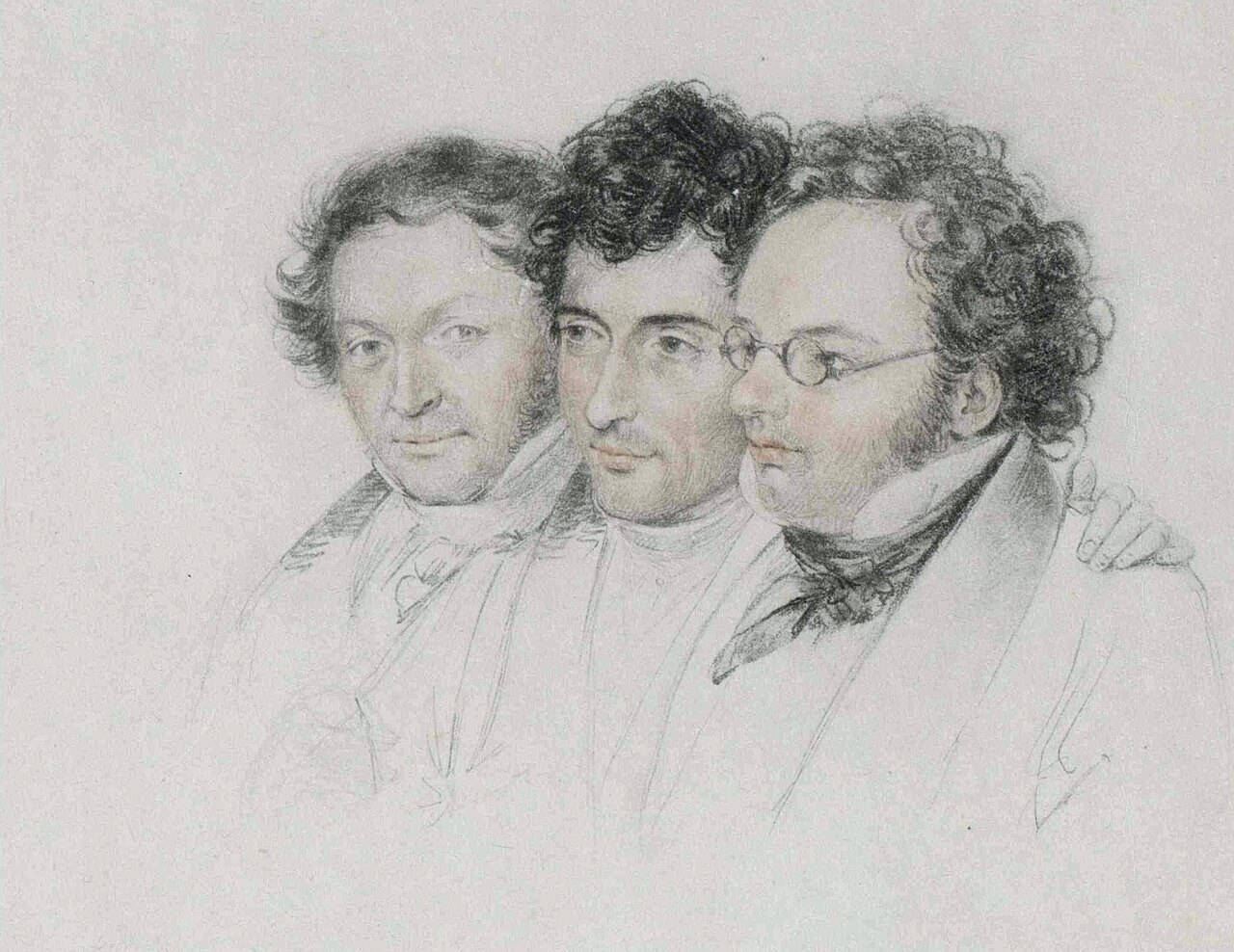
Johann Baptist Jenger, Anselm Hüttenbrenner and Franz Schubert
Josef Teltscher, Watercolour, 1827
Declining health may not have been the sole cause of the dark mood that fell upon Schubert in October and November whilst working on the last songs of Winterreise. "For a time", recalled Spaun in 1858, "Schubert’s mood became gloomy and he seemed upset … One day he said to me ‘come to Schober’s today and I will sing you a cycle of grisly songs … They have affected me more than has been the case with any other songs’." Whether he was suffering from illness or depression, or just gloom associated with these songs, Schubert was nevertheless able at the same time – in October – to produce the ebullient Piano Trio in B-flat (D898), and in November its bigger brother the E-flat Piano Trio (D929). The great pity is that for the first time in this year we should know so little of Schubert’s appearances amongst his friends, his opinions and his moods, the Hartmann brothers having ceased to maintain their diaries. Perhaps this gloom did not last too long, for by December a second set of four Impromptus (D935) appeared from his pen; some authorities would prefer to date the robust E-flat Piano Trio from this month; and from December also comes the work that demands extreme virtuosic powers from both violinist and pianist, the Fantasia in C (D934) written especially for Slawjk and Bocklet to be able to display their brilliance.
Notable works of 1827:
D897 E flat major Notturno Original slow mvt. for D898? pf,vn,vc 1827 cOctD898 B flat major Piano Trio 1 Op.99 pf,vn,vc 1827 cOct
D899 Four Impromptus: c, E flat, G flat, A flat pf 1827 Summer-Autumn
D911 Winterreise Müller songcycle 1827 Feb&Oct
D929 E flat major Piano Trio 2 Op.100 pf,vn,vc 1827 Nov
D934 C major Fantasy for violin & piano vn,pf 1827 Dec
D935 Four Impromptus: f, A flat, B flat, f pf 1827 Dec
Introduction | 1805-13 | 1814 | 1815 | 1816 | 1817 | 1818 | 1819 | 1820 | 1821 | 1822 | 1823 | 1824 | 1825 | 1826 | 1827 | 1828